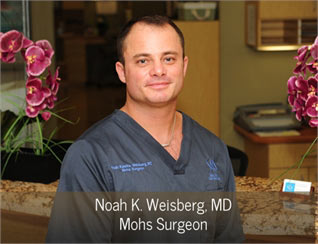
About Dr. Noah Weisberg, MD
Noah Kawika Weisberg, M.D. is a fellowship-trained Mohs surgeon, board-certified by the American Board of Dermatology, and a Fellow of the American College of Mohs Surgery. In 2002, Dr. Weisberg relocated to Palm Beach County, dedicating his practice to the surgical treatment of skin cancer utilizing the Mohs surgical technique. Since coming to Palm Beach County, Dr. Weisberg has removed over 28,000 skin cancers utilizing Mohs surgery.
Dr. Weisberg takes great pride in providing expert and efficient care. His approach in the treatment of skin cancer begins with meticulous attention to the complete removal of any cancerous cells utilizing the Mohs micrographic surgical technique. In addition to microscopically ensuring clear surgical margins, Dr. Weisberg spares as much normal tissue as the growth of cancer will allow.
Keeping the surgical wound as small as possible provides the best starting point for any necessary reconstructive surgery. Aesthetic reconstruction following the removal of skin cancer is of the highest priority. In most cases, Dr. Weisberg will perform the reconstruction of the surgical site in the office immediately after the cancer is removed. In some circumstances, he works with other surgical specialists for the reconstructive portion of the procedure should their expertise become necessary.
Dr. Weisberg was born on the Big Island of Hawaii and raised on Long Island, New York. He received his education at Emory University, graduating summa cum laude with a bachelor of science in biology. Dr. Weisberg attended medical school at Vanderbilt University where he graduated in the top 5% of his class. He interned at the Mayo Clinic and completed his residency in Dermatology at The New York-Presbyterian Hospital Cornell University Medical Center, the Memorial Sloan Kettering Cancer Institute, and the Hospital for Special Surgery. He served as Chief Resident for all three of these institutions. Dr. Weisberg went on to complete his Mohs surgery fellowship at the Skin and Laser Surgery Center of Pennsylvania.
Dr. Weisberg empathizes that having surgery can be stressful and does everything possible to help patients through their treatment in a pleasant and warm setting. You will find that Dr. Weisberg’s office remains on schedule the vast majority of the time. Your time is important and this office goes to great lengths to efficiently care for patients. One of the best recommendations a physician can receive is from past patients. Dr. Weisberg works to achieve this by providing the highest level of care.
Dr. Weisberg takes great pride in providing expert and efficient care. His approach in the treatment of skin cancer begins with meticulous attention to the complete removal of any cancerous cells utilizing the Mohs micrographic surgical technique. In addition to microscopically ensuring clear surgical margins, Dr. Weisberg spares as much normal tissue as the growth of cancer will allow.
Keeping the surgical wound as small as possible provides the best starting point for any necessary reconstructive surgery. Aesthetic reconstruction following the removal of skin cancer is of the highest priority. In most cases, Dr. Weisberg will perform the reconstruction of the surgical site in the office immediately after the cancer is removed. In some circumstances, he works with other surgical specialists for the reconstructive portion of the procedure should their expertise become necessary.
Dr. Weisberg was born on the Big Island of Hawaii and raised on Long Island, New York. He received his education at Emory University, graduating summa cum laude with a bachelor of science in biology. Dr. Weisberg attended medical school at Vanderbilt University where he graduated in the top 5% of his class. He interned at the Mayo Clinic and completed his residency in Dermatology at The New York-Presbyterian Hospital Cornell University Medical Center, the Memorial Sloan Kettering Cancer Institute, and the Hospital for Special Surgery. He served as Chief Resident for all three of these institutions. Dr. Weisberg went on to complete his Mohs surgery fellowship at the Skin and Laser Surgery Center of Pennsylvania.
Dr. Weisberg empathizes that having surgery can be stressful and does everything possible to help patients through their treatment in a pleasant and warm setting. You will find that Dr. Weisberg’s office remains on schedule the vast majority of the time. Your time is important and this office goes to great lengths to efficiently care for patients. One of the best recommendations a physician can receive is from past patients. Dr. Weisberg works to achieve this by providing the highest level of care.
Patient Education Resources
How can I reduce the skin redness caused by rosacea?
There are several ways to reduce the skin redness caused by rosacea:Avoiding triggers: Triggers such as sun exposure, wind, high temperatures, stress, spicy foods, and alcohol, can worsen the symptoms...
There are several ways to reduce the skin redness caused by rosacea:Avoiding triggers: Triggers such as sun exposure, wind, high temperatures, stress, spicy foods, and alcohol, can worsen the symptoms...
How Does Isotretinoin Work to Treat Acne?
Isotretinoin, previously marketed as Accutane, is a medication that is used to treat severe cystic acne that has not responded to other treatments. Isotretinoin is a form of vitamin A and works by ...
Isotretinoin, previously marketed as Accutane, is a medication that is used to treat severe cystic acne that has not responded to other treatments. Isotretinoin is a form of vitamin A and works by ...
How is atopic dermatitis different from eczema?
Atopic dermatitis and eczema are often used interchangeably, but they are not exactly the same thing. Atopic dermatitis is a type of eczema.Eczema is a general term that refers to a group of condition...
Atopic dermatitis and eczema are often used interchangeably, but they are not exactly the same thing. Atopic dermatitis is a type of eczema.Eczema is a general term that refers to a group of condition...
How long does it take for a tattoo to disappear after laser tattoo removed?
The length of time it takes to remove a tattoo depends on several factors, including the size, location, and color of the tattoo, as well as the individual's skin type and overall health.The most ...
The length of time it takes to remove a tattoo depends on several factors, including the size, location, and color of the tattoo, as well as the individual's skin type and overall health.The most ...
What is atopic dermatitis?
Atopic dermatitis, also known as eczema, is a chronic, inflammatory skin condition that causes dry, itchy, and scaly skin. The condition is characterized by symptoms such as:Dry, itchy skin: The skin ...
Atopic dermatitis, also known as eczema, is a chronic, inflammatory skin condition that causes dry, itchy, and scaly skin. The condition is characterized by symptoms such as:Dry, itchy skin: The skin ...
Education & Training
- Residency: New York Presbyterian Hospital
- Internship: Mayo School of Graduate Medical Education
- Medical School: Vanderbilt University School of Medicine